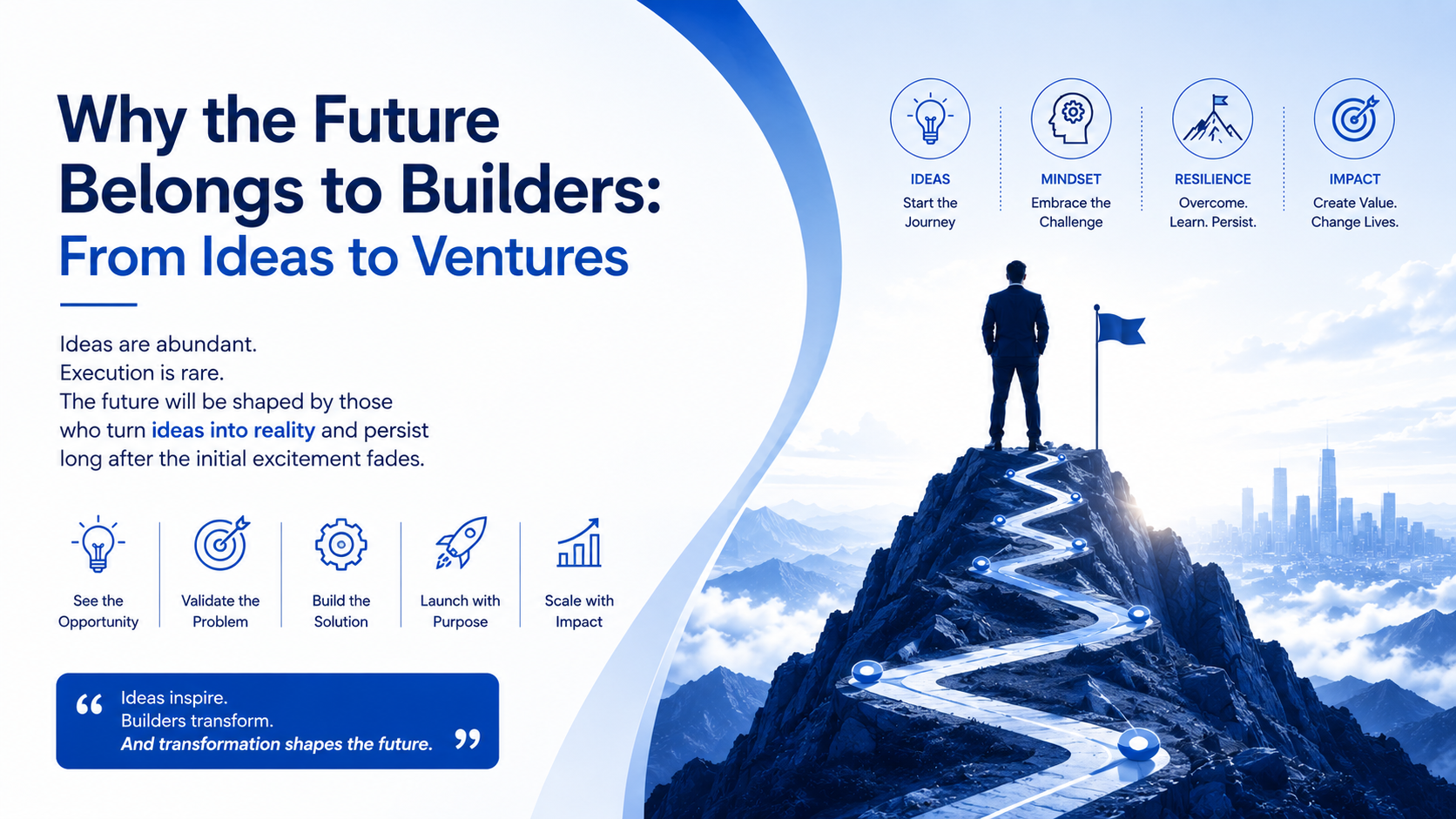
Why the Future Belongs to Builders: From Ideas to Ventures
Some emerge during conversations. Some appear during moments of frustration. Some arrive when we recognize a problem that nobody seems to be solving well.
Yet most ideas never become products. Most products never become businesses. And most businesses never create meaningful impact.
Why?
Because ideas are abundant.
Execution is rare.
After more than two decades of building teams, products, businesses, and ventures, I’ve learned that success rarely belongs to the person with the best idea.
It belongs to the person willing to build.
The World Doesn’t Need More Ideas
One of the biggest misconceptions about entrepreneurship is that success begins with innovation.
In reality, success often begins with observation.
Most successful ventures are not created because someone invented something entirely new.
They are created because someone noticed:
A broken process An underserved customer An inefficient experience A recurring frustration
Every venture I have been involved in started with a problem.
Not a product.
Not a technology.
Not a pitch deck.
A problem.
The best builders fall in love with solving problems, not with their ideas.
Because ideas evolve.
Problems remain.
The Shift from Employee to Entrepreneur
One of the most significant mindset shifts in my career was moving from executing someone else’s vision to creating my own.
As employees, we are often trained to:
Deliver outcomes Follow processes Execute efficiently Minimize risk
Entrepreneurs operate differently.
They must:
Create clarity where none exists Make decisions with incomplete information Take responsibility for outcomes Embrace uncertainty
The transition is not easy.
There is no roadmap.
No guaranteed outcome.
No certainty.
But that’s precisely what makes building rewarding.
Entrepreneurship teaches you to think differently.
It forces you to become comfortable with ambiguity.
And it develops a level of resilience that no corporate training program can teach.
Building Products That Solve Real Problems
Technology has made it easier than ever to build products.
But building products people actually need remains difficult.
One lesson I’ve learned repeatedly is this:
Customers don’t buy features.
They buy solutions.
The most successful products are not the most sophisticated.
They are the most relevant.
Before building any solution, I ask:
What problem are we solving? Who experiences this problem? How painful is it? Why hasn’t it been solved effectively already?
Whether it’s HR technology, talent verification, staffing solutions, food services, or enterprise software, the principle remains the same.
The product must solve a real problem.
Everything else is secondary.
Execution Is the Ultimate Competitive Advantage
Many ventures fail not because of bad ideas.
They fail because execution stops when enthusiasm fades.
The early stages of building are exciting.
The vision feels limitless.
The possibilities seem endless.
Then reality arrives.
Deadlines. Resource constraints. Market feedback. Customer expectations. Unexpected setbacks.
This is where builders are separated from dreamers.
Execution is not glamorous.
It’s repetitive.
It’s disciplined.
It’s often invisible.
But it is the single greatest differentiator between ideas that remain concepts and ideas that become companies.
Resilience Matters More Than Talent
One of the biggest lessons entrepreneurship has taught me is that resilience often matters more than intelligence.
Every venture experiences:
Delays Rejections Failures Unexpected challenges
The question is never whether obstacles will appear.
The question is how you respond when they do.
Some of the most successful founders I know are not necessarily the smartest people in the room.
They are the most persistent.
They continue building when excitement disappears.
They continue learning when results are slow.
They continue showing up when others quit.
Resilience is often the hidden engine behind every successful venture.
Balancing Innovation with Execution
Innovation without execution creates ideas.
Execution without innovation creates stagnation.
The best builders balance both.
They dream big enough to inspire action.
But they execute pragmatically enough to create results.
This balance is critical.
Too much focus on innovation creates endless experimentation.
Too much focus on execution creates incremental thinking.
The future belongs to leaders who can imagine possibilities and build them systematically.
Why Builders Will Shape the Future
We are entering an era where technology, AI, automation, and digital transformation are changing industries faster than ever.
The opportunities ahead are enormous.
But opportunity alone changes nothing.
Someone must build.
Someone must create.
Someone must solve problems.
Someone must turn possibilities into products and products into businesses.
That’s why I believe the future belongs to builders.
Not because they have all the answers.
But because they are willing to start before they do.
They take ownership.
They embrace uncertainty.
They persist through challenges.
And they continue building long after the initial excitement fades.
Final Thoughts
Looking back, the ventures, products, and teams I’ve helped build have taught me one simple truth:
The distance between an idea and impact is execution.
The future will not be shaped by those who simply imagine possibilities.
It will be shaped by those willing to build them.
Because ideas inspire.
But builders transform.
And transformation is what changes industries, organizations, and lives.