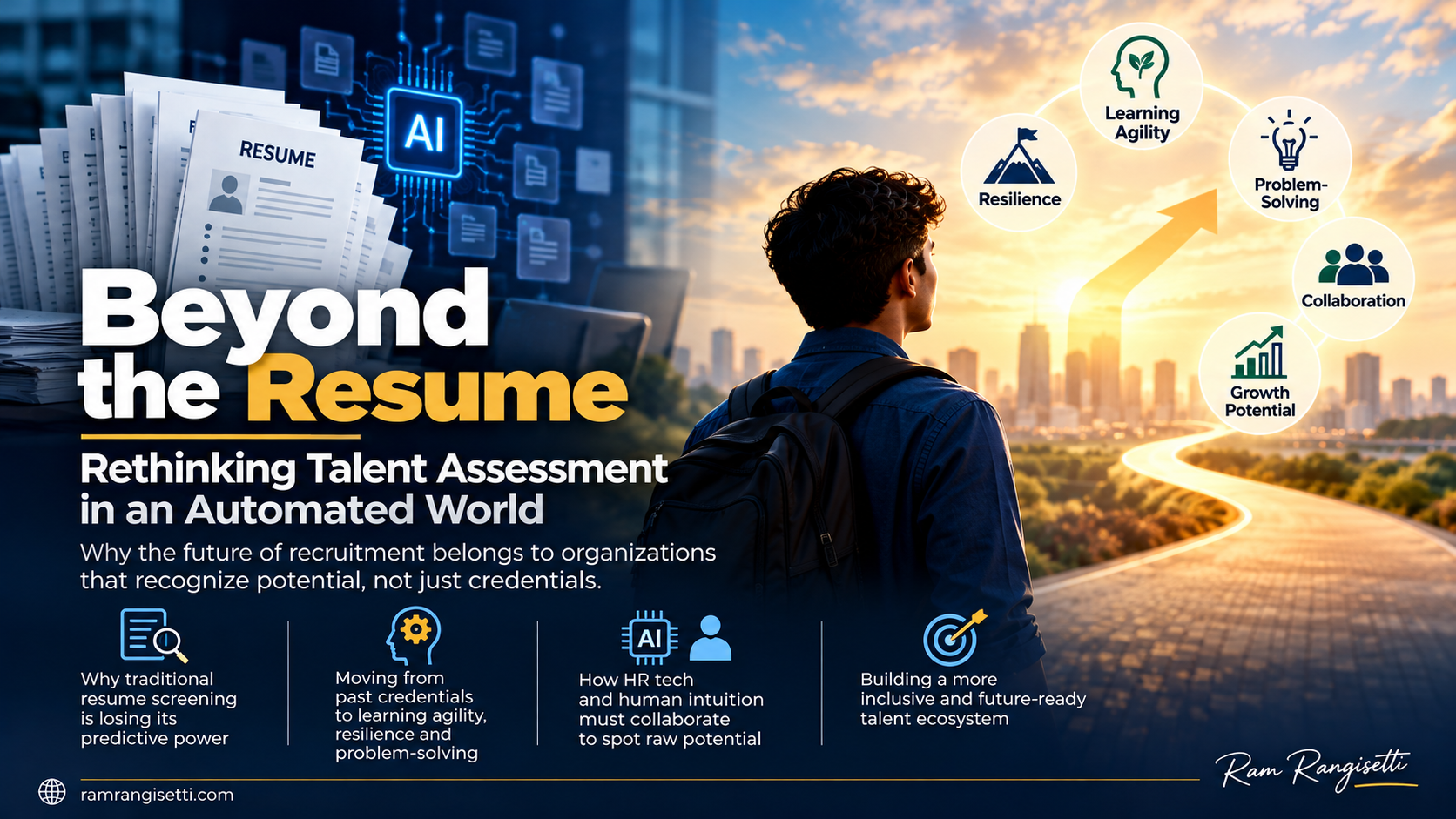
Beyond the Resume: Rethinking Talent Assessment in an Automated World
The Resume Is Evolving. Is Our Hiring Strategy Keeping Up? For decades, the resume has been the foundation of recruitment. A carefully structured document highlighting education, professional experience, technical skills, certifications, and career achievements has traditionally determined whether a candidate progresses to the next stage of hiring.
But we are entering a fundamentally different era.
Today, artificial intelligence can generate a polished resume in seconds. AI-powered tools can optimize applications against job descriptions, identify relevant keywords, and even automate applications across hundreds of opportunities. The result? Recruiters are receiving more applications than ever, but identifying genuinely capable talent is not necessarily becoming easier. We have made it incredibly easy to present qualifications. We have not made it equally easy to demonstrate capability.
This raises an important question for business leaders, HR professionals, and talent acquisition teams: Are we still hiring the best talent, or are we simply hiring the candidates who know how to navigate our screening systems?
I believe the answer requires us to rethink how we define, discover, and evaluate talent.
1. The Growing Disconnect Between Resumes and Real Capability Traditional recruitment systems were designed around a relatively straightforward assumption: past achievements and professional credentials provide useful indicators of future performance.
While this assumption still has merit, it is increasingly insufficient.
Consider two candidates applying for the same technology role.
Candidate A has an impressive resume, prestigious certifications, experience with recognized organizations, and excellent keyword alignment with the job description.
Candidate B comes from a lesser-known organization, has fewer formal certifications, and may not have worked with the exact technology stack. However, this candidate demonstrates exceptional analytical thinking, adaptability, curiosity, and the ability to solve unfamiliar problems.
Who would your recruitment system shortlist? In many organizations, Candidate A would receive priority.
But who would perform better six months after joining? That question cannot be answered by a resume alone. The problem is not that resumes have become irrelevant. The problem is that we often expect them to reveal capabilities they were never designed to measure.
A resume can tell us where someone has worked. It cannot reliably tell us how quickly they learn. It can describe responsibilities. It cannot fully demonstrate how someone responds when a project fails. It can list technologies. It cannot establish whether someone can solve a problem they have never encountered before. A resume represents a candidate's professional history. It should not be mistaken for the complete measure of their professional potential.
2. From Experience-Based Hiring to Potential-Based Hiring As technology evolves, the useful life of specific technical knowledge can become shorter. A skill that is highly relevant today may require significant updating tomorrow. This makes three human capabilities increasingly important. Learning Agility: The Ability to Evolve Learning agility is not simply the willingness to attend training programs or obtain certifications. It is the ability to absorb unfamiliar information, challenge existing assumptions, apply new knowledge, and adapt behavior based on experience.
Imagine hiring a software engineer who has never worked with a particular cloud platform but has repeatedly demonstrated the ability to learn new architectures and deliver successful implementations. Would that person be less valuable than someone who knows the platform but struggles to adapt when requirements change? Not necessarily.
Organizations should begin asking candidates: “Tell me about a situation where you had to learn something completely unfamiliar to solve a business problem. How did you approach it?” The answer can reveal much more than a certification list.
Resilience: The Ability to Navigate Uncertainty Modern workplaces are characterized by constant change. Projects get delayed. Technologies become obsolete. Customer expectations shift. Business priorities evolve. The strongest professionals are not necessarily those who have experienced the fewest failures. They are often those who have learned how to recover, adapt, and move forward. Recruitment assessments should explore how candidates handle setbacks, accept feedback, manage uncertainty, and take responsibility for outcomes.
A useful question might be: “Describe a professional setback that forced you to change your approach. What did you learn, and what would you do differently today?” The objective is not to reward candidates for having dramatic stories. It is to understand how they reflect, learn, and respond to challenges.
Problem-Solving: The Ability to Create Value In a world where AI can retrieve information, generate code, summarize documents, and recommend solutions, simply possessing information is becoming less of a differentiator. The ability to apply knowledge effectively is what matters. Can a candidate identify the real problem? Can they distinguish symptoms from root causes? Can they evaluate trade-offs? Can they make decisions with incomplete information? Can they explain their reasoning? These are capabilities that become visible through thoughtfully designed assessments, practical simulations, and structured discussions. The future of talent assessment should focus less on what candidates claim to know and more on how they think, learn, and create value.
3. AI Should Improve Recruitment Decisions, Not Replace Human Judgment Artificial intelligence has enormous potential to improve recruitment. It can help recruiters organize applications, identify relevant experience, recognize transferable skills, and reduce repetitive administrative work. But AI introduces an important challenge. If algorithms are trained to recognize patterns associated with historically successful candidates, they may unintentionally reinforce existing hiring preferences. Candidates from unconventional backgrounds, emerging industries, smaller organizations, or nontraditional career paths could be overlooked. This is where human judgment becomes essential. Technology can help identify evidence. Human expertise must help interpret that evidence. For example, an AI-powered screening platform might identify that a candidate lacks direct experience with a particular technology. A skilled recruiter might recognize that the candidate has mastered several related technologies and could become productive with limited training. Neither technology nor intuition should operate without accountability. Human judgment can also be influenced by unconscious biases, first impressions, and familiarity. The solution is not to replace algorithms with intuition. It is to create a recruitment model in which both are supported by structured, job-relevant evidence. AI should expand our ability to discover talent, while human judgment helps us understand the potential behind the profile.
4. Rethinking the Talent Assessment Framework I believe organizations should move toward a more comprehensive assessment model. Instead of evaluating candidates primarily through resumes and conventional interviews, recruitment teams should examine five dimensions of talent. Assessment Dimension What Organizations Should Evaluate Technical Capability: Can the candidate demonstrate the knowledge and skills required for the role? Learning Agility: How effectively can the candidate acquire and apply new knowledge? Problem-Solving Ability: Can the candidate analyze unfamiliar challenges and develop practical solutions? Adaptability and Resilience: How does the candidate respond to uncertainty, feedback, and setbacks? Collaboration and Communication: Can the candidate work effectively with others and communicate ideas clearly?
These dimensions should not receive identical weight for every position. For example, a cybersecurity specialist may require a higher threshold of verified technical expertise, while an emerging technology role may place greater emphasis on learning agility. The objective is to build a role-specific assessment framework rather than introduce another generic scoring mechanism. Organizations can implement this approach through practical work samples, structured behavioral interviews, scenario-based exercises, and consistent evaluation rubrics. Importantly, assessments should be accessible, proportionate to the role, and respectful of candidates' time.
5. The Next Evolution: An Intelligent Talent Ecosystem What excites me most is the possibility of moving beyond isolated recruitment transactions toward an intelligent talent ecosystem. Imagine a platform where a candidate is not defined solely by an uploaded resume. Instead, their professional profile evolves through demonstrated capabilities, verified achievements, skill assessments, learning progress, and career aspirations. Such an ecosystem could help organizations: - Identify candidates with transferable skills who might otherwise be overlooked. - Discover emerging talent beyond conventional educational and employer filters. - Recommend learning pathways to close specific capability gaps. - Match individuals with opportunities based on both current readiness and future potential. - Build long-term relationships with candidates instead of restarting the hiring process for every vacancy. However, such systems must be designed responsibly. Candidates should understand how their information is evaluated, have opportunities to correct inaccuracies, and retain meaningful control over their personal data. Assessment models should be monitored for unfair outcomes and validated against actual job performance. The goal should not be to assign every individual a permanent numerical score. It should be to create a more complete, evidence-based understanding of their capabilities and growth potential.
6. Recruitment Must Become a Strategic Capability For many years, recruitment efficiency has been measured through metrics such as time-to-fill, cost-per-hire, application volumes, and offer acceptance rates. These metrics remain important. But they do not necessarily tell us whether an organization is consistently identifying the right people. We need to pay greater attention to quality of hire, performance after joining, retention, internal mobility, and the speed at which employees develop new capabilities. Recruitment should not end with identifying someone who matches today's job description. It should help organizations identify people who can contribute to tomorrow's business challenges. That requires closer collaboration between talent acquisition teams, hiring managers, learning and development professionals, and business leadership. It also requires a change in mindset. Instead of asking only: “Does this candidate have the required experience?” We should also ask: “Does this candidate have the capability to succeed, adapt, and grow in this role?” These questions are not mutually exclusive. The strongest hiring decisions consider both.
7. The Human Advantage in an Automated World As AI continues to transform recruitment, there is a temptation to believe that better algorithms alone will solve our hiring challenges. I see things differently. Technology will certainly make recruitment faster, more scalable, and potentially more insightful. But the real competitive advantage will come from how intelligently organizations combine technology with human understanding.
A candidate is more than a collection of keywords. Potential is more than a matching percentage. And talent is more than a resume.
The organizations that succeed will be those that look beyond conventional credentials, create meaningful opportunities for people to demonstrate capability, and recognize potential wherever it exists. Because ultimately, the future of recruitment is not about finding the best resume. It is about discovering the person best equipped to create value. And sometimes, that person may not have the most impressive resume in the applicant pool.
Final Thought We have spent decades teaching technology how to read resumes. Perhaps it is time we invested equally in teaching our recruitment systems how to recognise human potential. That, I believe, is where the next meaningful transformation in talent acquisition will begin.