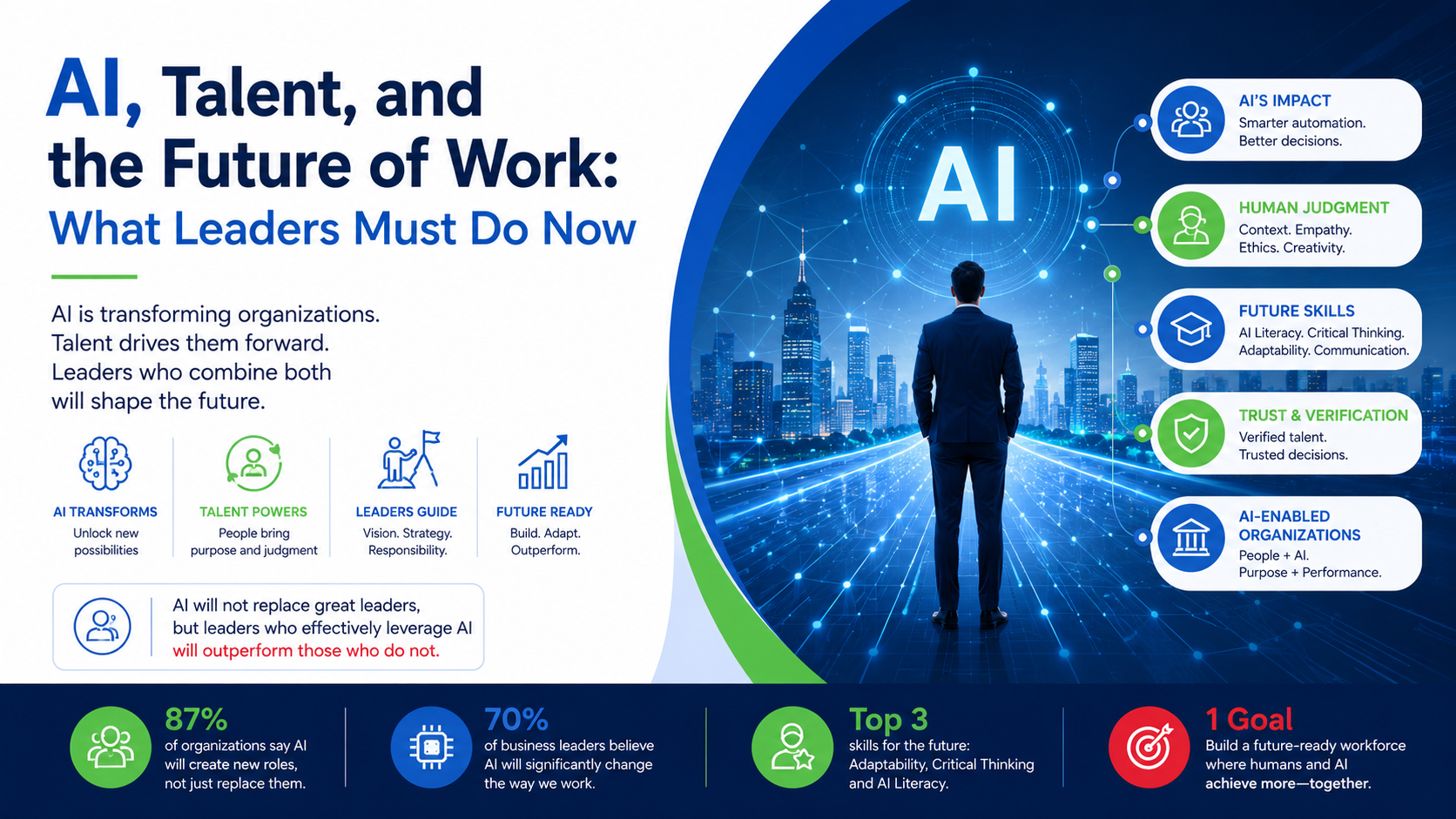
AI, Talent, and the Future of Work: What Leaders Must Do Now
For the first time in modern business history, organizations are not just preparing people to work with technology. They’re preparing technology to work alongside people.
Artificial Intelligence has moved beyond experimentation. It is reshaping how organizations hire, build products, make decisions, serve customers, and compete.
Yet after countless conversations with business leaders, HR professionals, founders, and technology teams, I’ve noticed something interesting. The organizations succeeding with AI are not necessarily the ones with the biggest AI budgets.
They are the ones that understand one simple truth:
- AI transforms organizations. People determine whether that transformation succeeds.
- We Have Moved Beyond the AI Hype
- Over the past few years, nearly every organization has launched an AI initiative.
- Some have invested heavily. Others are still experimenting, But many are discovering the same challenge.
AI alone doesn’t create business value. Execution does.
According to several industry reports, many AI initiatives never move beyond pilot programs, not because the technology fails, but because organizations struggle with adoption, governance, change management, and trust.
The conversation has shifted.
The question is no longer: “Should we adopt AI?”
The question is: “How do we build an organization that can work effectively with AI?”
That is a leadership challenge. Not a technology challenge.
AI Changes Work. It Doesn’t Eliminate the Need for People.*
Every major technology wave has created similar fears.
- Cloud computing.
- Automation.
- The Internet.
- Mobile.
AI is different in capability—but similar in outcome. It changes work. It rarely removes the need for people entirely. Routine, repetitive, and rule-based tasks will increasingly be handled by AI. But organizations will continue to depend on people for what machines cannot consistently replicate:
- * Judgment
- * Creativity
- * Context
- * Ethics
- * Leadership
- * Empathy
- * Collaboration
The future belongs to organizations that combine machine intelligence with human intelligence—not one replacing the other. Human Judgment Becomes the New Competitive Advantage.
As AI becomes more capable, human judgment becomes more valuable.
Why?
Because AI can generate answers. But, It cannot always determine whether those answers are appropriate for a specific business, customer, culture, or ethical situation.
Future leaders must become better at:
Asking better questions Validating AI-generated outcomes Making decisions under uncertainty Balancing speed with responsibility
The value shifts from knowing information to interpreting information. From creating content to evaluating quality. From executing tasks to making better decisions. Judgment becomes leadership’s most valuable capability.
The Skills Every Leader Must Build
The leadership playbook is changing. Tomorrow’s leaders will need capabilities that extend beyond technology.
AI Literacy: Every leader should understand how AI works, where it adds value, and where human oversight remains essential. AI literacy will become as fundamental as digital literacy.
Critical Thinking: AI provides possibilities. Leaders provide direction. Questioning assumptions, validating recommendations, and making balanced decisions will become essential leadership skills.
Adaptability: Technology will continue evolving faster than organizational structures. Leaders must become comfortable learning, unlearning, and adapting continuously.
Communication: Successful AI adoption is ultimately about people. Leaders must help teams understand not only what is changing, but why. Clarity reduces resistance. Trust accelerates adoption.
Hiring Will Never Be the Same Again
Recruitment is already being transformed by AI.
- Resume screening.
- Candidate matching.
- Interview scheduling.
- Skill analysis.
- Predictive insights.
These capabilities improve efficiency. But hiring has never been purely an efficiency problem. It is a decision problem.
Organizations still need leaders and recruiters who can evaluate:
- * Cultural alignment
- * Leadership potential
- * Learning agility
- * Character
- * Motivation
The future of recruitment is not AI versus recruiters. It is AI enabling recruiters to make better decisions. Trust Will Become the New Currency
As AI-generated resumes, synthetic identities, and automated applications become increasingly common, organizations face a new challenge.
Can they trust the information they receive? Verification is becoming just as important as recruitment. - This is where I am building a BGV repository platform ## Credenza International.
The organizations that build trusted hiring ecosystems will have a significant competitive advantage through Credenza International.
This is where technologies focused on credential verification, identity validation, employment verification, and trusted workforce data will play an increasingly strategic role.
In an AI-driven hiring world: Trust becomes infrastructure. Building AI-Enabled Organizations Successful AI adoption is not about deploying another tool. It requires organizational transformation.
Leaders must focus on: Building AI-ready cultures Upskilling existing employees Creating governance frameworks Encouraging experimentation * Measuring business outcomes rather than technology adoption
The organizations that thrive will be those that view AI as a capability multiplier—not simply an automation engine.
Leadership in the AI Era
Throughout my career, I’ve seen multiple waves of technological transformation.
What remains constant is this:
Technology changes how we work. Leadership determines whether people embrace that change. The leaders who succeed over the next decade will not necessarily be AI experts.
They will be leaders who combine:
Technology with empathy Innovation with governance Automation with human judgment Data with purpose
Because AI alone doesn’t create competitive advantage. People who know how to lead with AI do.
Final Thoughts:
The future of work will not be defined by artificial intelligence alone. It will be defined by organizations that understand how to combine human capability with machine intelligence.
AI will automate tasks. People will continue to create purpose. AI will improve speed. People will determine direction. AI will assist decisions. Leaders will own accountability.
The organizations that understand this balance today will become the industry leaders of tomorrow.
AI will not replace great leaders. But leaders who effectively leverage AI will outperform those who do not.